
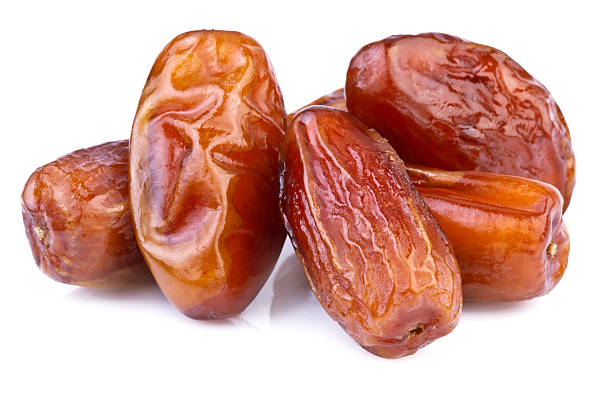
This post's title promises that a raw diet makes weight loss easy. Part of the case is plain arithmetic: the raw vegetables and fresh fruit compared below carry few calories for their weight. Dates turn up in raw recipes too (the older version of this post used Medjool in a raw cake), but they sit at the opposite end of that scale, and a raw plan that leans on them can run the other way.
Energy density, in one number
Energy density is the number of calories in a gram of food. It is why one plate can be large and still light, while a small handful of something else is heavy on calories.
USDA FoodData Central gives these figures per 100g. Raw cucumber with peel has 15 kcal, raw carrot 41 kcal and a raw apple with skin 52 kcal. Medjool dates have 277 kcal, and almonds 579 kcal.
Turn that round and look at what 100 kcal buys. It is about 670g of cucumber, about 245g of carrot or about 190g of apple. The same 100 kcal is only about 36g of Medjool, roughly one and a half dates, and about 17g of almonds, a small pinch.
Water is one big difference. In FoodData Central, 100g of cucumber holds 95.2g of water and 100g of apple 85.6g. The same weight of Medjool holds 21.3g, and of almonds 4.41g.
A year-long trial built on that idea
A team at Pennsylvania State University tested energy density on weight directly, in a trial published in 2007 (PubMed 17556681). They randomly assigned 97 women with obesity to one of two kinds of advice. One group was told to cut fat. The other was told to cut fat and also eat more water-rich foods, particularly fruit and vegetables. Nobody was given a calorie target, and both groups could eat as much as they liked while following their advice.
After a year, the 71 women who finished had lost weight in both groups. The fruit and vegetable group lost 7.9kg on average and the fat-only group 6.4kg, and the pattern of weight loss differed significantly between them. The fruit and vegetable group ate a greater weight of food, their diet had a lower energy density, and they reported less hunger.
This was not a raw food study. What it does support is the part of the raw idea that holds up: filling the plate with water-rich fruit and vegetables let these women eat more food by weight and still lose weight.
Where dates come in
The NHS counts dates as dried fruit, and it says 30g of dried fruit is equivalent to around 80g of fresh fruit, and either amount counts as 1 portion of your 5 A Day. Using the FoodData Central figures, 30g of Medjool is about 83 kcal and 80g of apple about 42 kcal. That is twice the energy for the same portion.
One pitted Medjool date weighs about 24g, which works out at about 66 kcal and 16g of sugars per date. The older version of this post described a raw cake held together by Medjool dates. Blended into a recipe like that, each date still adds its 66 kcal, whether you can see it or not.
The NHS names dates in that list with a condition: the 30g portion should be eaten at mealtimes, not as a snack between meals, to reduce the impact on teeth. That gives a simple rule for a raw plan. A date or two goes with a meal, next to a large bowl of the water-rich food that does the filling.

Nuts sit at the far end of the scale
The older version of this post suggested nuts as a filling snack. By weight, almonds are the most energy-dense food in this comparison, at 579 kcal per 100g, so a handful is worth weighing once to see what it adds up to. For anyone who wants the page the earlier post pointed to, the link to find more information is kept here.
Buying dates in Malaysia
Jual Kurma supplies dates to consumers, retailers and traders and offers fast delivery across Malaysia, according to its about us page. Enquiries go through WhatsApp, listed on the contact us page. Other articles on dates are on the Jual Kurma blog.
This article is general information, not personal advice. If you plan a big change to the way you eat, speak to your GP or a dietitian first.