
This list asks one question about breakfast and snacks. Which everyday foods have been tested against a swap, and did people end up eating less? Five made the cut. None of them melts fat, and a couple of the results are weaker than you might expect.
1. A bowl of oatmeal instead of boxed cereal
Researchers at Louisiana State University and Pennington Biomedical gave 48 healthy adults two breakfasts, a week or more apart (PubMed 26273900). One was oatmeal. The other was a ready-to-eat breakfast cereal also made from oats, served with the same calories. Lunch came four hours later.
After the oatmeal, people felt fuller and less hungry through the morning, and they ate less at lunch. The team linked the difference to the soluble oat fibre, beta-glucan, which was more viscous in the oatmeal. An earlier trial by the same group, also with 48 people, compared oatmeal with the best-selling boxed cereal at 363 kcal including milk and found the same pattern for fullness and hunger (PubMed 24024772). Several authors on the later paper worked for PepsiCo R&D, which is worth knowing when you read it.
2. Greek yogurt as the afternoon snack
At the University of Missouri, 15 healthy women with an average age of 26 ate a 160 kcal yogurt snack in the afternoon, with 5g, 14g or 24g of protein, or had no snack at all (PubMed 23022602). Each pattern ran for three days before the test day.
The higher the protein, the longer they waited before asking for dinner: 124 minutes with no snack, then 152, 158 and 178 minutes. They did eat less at dinner after a snack, but not 160 kcal less, so the snack added to the day's total.
A follow-up with 20 women compared a 160 kcal yogurt snack with crackers and chocolate of the same calories (PubMed 25266206). People ate about 100 kcal less at dinner after the yogurt than after the chocolate. Against the crackers, the gap was not statistically significant.
3. Popcorn rather than crisps
A study from the Rippe Lifestyle Institute in Florida tested 35 normal-weight adults aged 20 to 50 (PubMed 22978828). On separate visits they had water alone, one cup of low-fat popcorn (15 kcal), six cups of popcorn (100 kcal) or one cup of potato chips (150 kcal), each with 200ml of water, and then a meal where they could eat freely.
Six cups of popcorn left people less hungry and more satisfied than any of the other options. Counting the snack and the meal together, the chips day came to 803 kcal against 716 kcal for water alone. Neither popcorn day was significantly different from water. So popcorn did not bring the total significantly below water alone. It just did not push it up the way the chips did.
4. Pistachios in the shell
This one is about seeing what you have eaten. At a mid-western American university, 118 faculty and staff had pistachios in the shell on their desks for eight hours on two separate days, with a second bowl for the empty shells (PubMed 21704666). On one day the shells stayed in the bowl. On the other, the shell bowl was emptied every two hours.
With the shells left in view, people ate an average of 216 calories of pistachios. With the bowl cleared, they ate 264, a difference of 48. They felt no less full or satisfied on the lower day. The nut was the same both times, so the lesson is about the shells and the empty bowl, not pistachios as such.
5. Plain boiled potatoes
The University of Sydney study behind the "satiety index" fed 38 common foods, each in a 240 kcal serving, to groups of 11 to 13 people, and rated how full they felt over the next two hours against white bread at 100 (PubMed 7498104). Boiled potatoes scored highest at 323. A croissant scored lowest at 47, so the potatoes rated about seven times as filling for the same calories.
Foods with more protein, fibre and water tended to score higher, and fattier foods lower. Larger servings by weight also scored higher, and so did foods people rated as less tasty. That last point is worth keeping in mind. The NHS says it is best to eat potatoes without any added salt or fat.
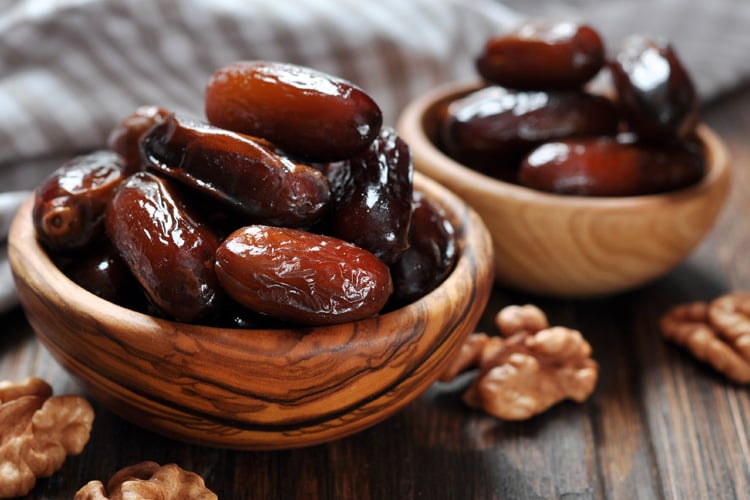
Where dates fit in all this
In the studies above, the more filling choice usually had more protein, more fibre or more volume for its calories, and the pistachio result came from a visual cue. USDA FoodData Central lists Medjool dates at 277 kcal per 100g, with 6.7g of fibre and 1.81g of protein. A 30g portion comes to about 83 kcal and 2g of fibre.
Timing matters too. The NHS counts 30g of dried fruit as one of your 5 A Day, and it names dates in that list. It also says dried fruit should be eaten at mealtimes, not as a snack between meals, to reduce the impact on teeth. That makes the oatmeal bowl a better home for chopped dates than the desk drawer. You get the sweetness inside a meal, in a portion you have measured.
Buying dates from Jual Kurma
Jual Kurma supplies dates to consumers, retailers and traders across Malaysia, with fast delivery nationwide, as its about us page explains. For questions or orders, use the WhatsApp number on the contact page. You can read more about dates on the Jual Kurma blog.
An earlier version of this post linked to https://KurmaHarga.com, and the link is kept here.
This article is general information, not personal advice. If you plan a big change to the way you eat, speak to your GP or a dietitian first.